Snow subcontractor handoffs need more than a property address and “take over from here.” When a truck breaks down or a route changes during a storm, the replacement operator needs the remaining scope, the last known conditions and a clear answer about who owns the next step. Use this handoff method to transfer responsibility without treating an unanswered message as acceptance.
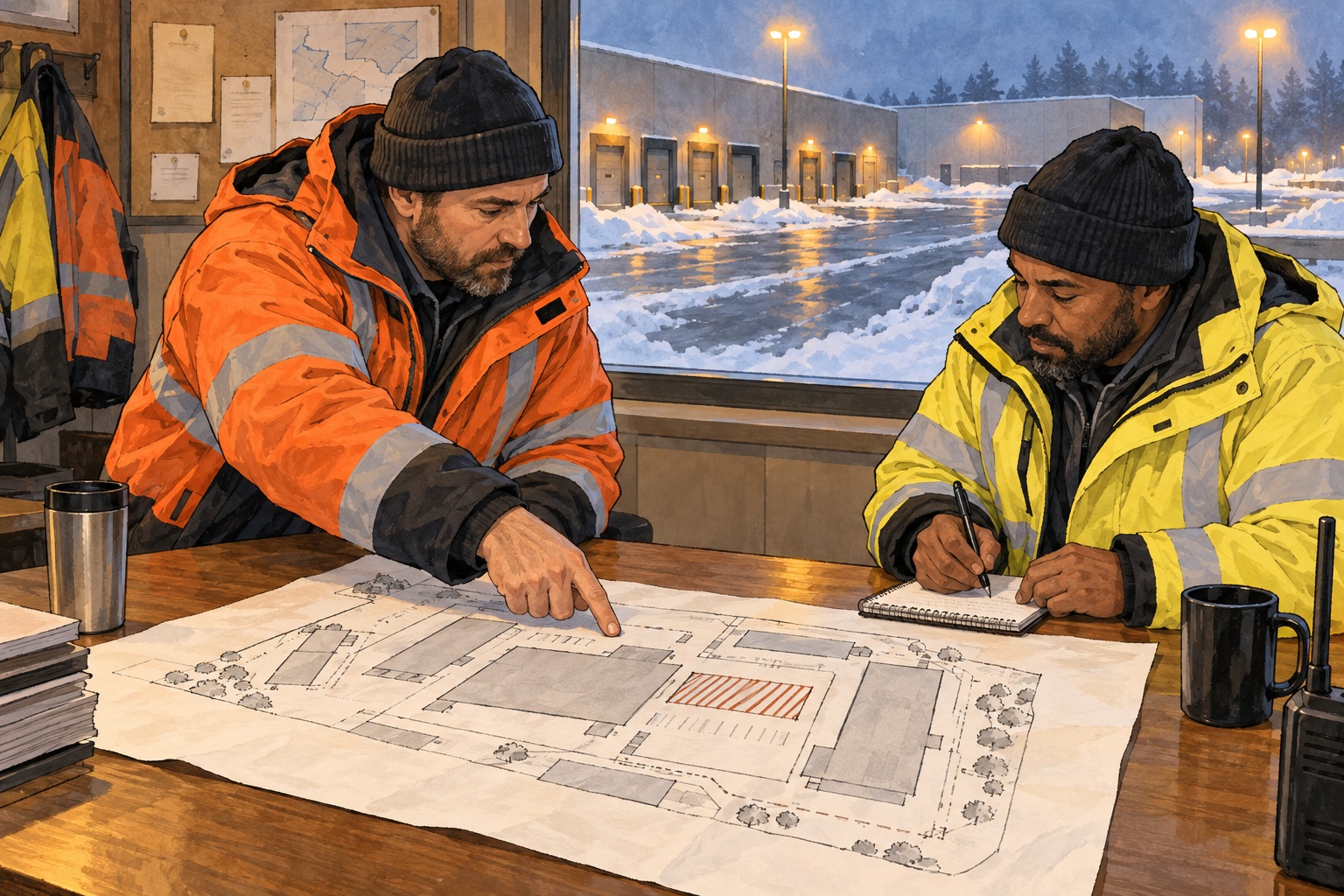
Image: Team at snow-contractor.com
Prepare the site packet before the storm
Keep a current site packet that a replacement operator can understand without the original driver's explanation. Build it from the agreed scope and an actual site review, not from a map alone.
SIMA's “Slip-and-fall pitfalls,” by Lisa Rose, published January 24, 2025, recommends a preseason site inspection covering the property drawing, services, operating hours, potential risk areas and snow-pile placement.[6] Use those categories as the foundation, then make the instructions specific enough for the person taking over tonight.
Include the information that changes the work
- Identity and access: Exact property, service entrance, permitted access arrangements and an authorized contact. Keep sensitive access credentials in your approved secure channel, not a broadly shared route sheet.
- Included and excluded areas: Mark lots, sidewalks, loading areas and entrances separately. State where another contractor or the customer handles a portion of the work.
- Priorities: Identify the agreed opening requirement and which areas come first. Do not let a replacement operator infer priority from whichever entrance is closest.
- Site constraints: Mark approved stacking areas, known obstacles and any restrictions on equipment or material.
- Escalation: Name the dispatcher or manager authorized to change scope, call backup or approve an extra service.
- Version: Add the packet's revision date and the person responsible for maintaining it.
Avoid copying an old packet forward without checking it. If the loading pattern or construction fencing changed, distribute the revision and obtain confirmation that the assigned operator has it.
Transfer ownership with an explicit acceptance
Use a consistent sequence: assignment, acceptance, service, exception review and closeout. These are recommended operating stages, not claims about automatic status buttons in any product.
The dispatcher should identify the outgoing operator, incoming operator, affected property and exact remaining task. The incoming operator should read back the property, scope and expected arrival. Until acceptance is recorded, keep the task marked as awaiting coverage in your dispatch process; do not count a sent message as staffed capacity.
For an active hazard, injury or urgent access problem, use the appropriate emergency or escalation procedure rather than waiting for routine digital acknowledgement.
Send a short handoff message
Use this original template in your approved dispatch channel:
- Property and event: Which site and which storm does this concern?
- Outgoing status: What was completed, at what time, and by whom?
- Remaining scope: What is unfinished or needs inspection?
- Changed conditions: What was observed, where, and when?
- Incoming responsibility: Who is taking over, and what arrival estimate have they confirmed?
- Authority and callback: Who approves changes, and when should dispatch escalate if acceptance or arrival is missing?
- Closeout required: Which service record and exception update must come back?
Keep an arrival estimate separate from the actual arrival record. If the estimate changes, update the responsible dispatcher rather than letting the old time become the office's assumed fact.
Example: a breakdown with unfinished loading lanes
This is an illustrative dispatch exercise, not a real customer story. The site, names and times are fictional.
At 2:20 a.m. Eastern, Operator A reports a mechanical problem at Training Warehouse B. The employee entrance and main drive are plowed, but the east loading lanes remain unfinished. A delivery vehicle blocks one lane. The last service record covers only the completed areas; it does not mark the property complete.
The dispatcher contacts Subcontractor B with the current site packet and a limited assignment: finish the accessible loading lanes and report whether the blocked lane can be serviced. B confirms the site and scope, estimates arrival at 2:50 a.m., and identifies the dispatcher as the decision-maker if the obstruction remains.
That acceptance transfers the specified unfinished work, not every possible future obligation at the property. The dispatcher separately confirms which crew retains sidewalk responsibility and who will handle any later inspection required by the contract.
On arrival, B records the actual time and observed conditions. If the obstruction remains, B reports the exception rather than improvising an unauthorized maneuver. Dispatch arranges the next step with the appropriate site contact. B's service record describes B's work; it does not overwrite A's earlier visit.
Close the operational handoff before reconciling payment
Review completion against the assignment, not just the subcontractor's total hours. Ask whether the incoming crew finished the transferred scope, whether a blocked area still needs attention, and whether someone accepted the follow-up.
Then compare the subcontractor's invoice with the contract and the service records. A return inspection, an additional push and a material application may be different line items under your agreement. Preserve that distinction instead of converting everything into a generic “storm service.” Investigate overlaps before approval; two records at one property can represent separate legitimate tasks rather than duplicate work.
SIMA also recommends retaining customer communications and documenting areas that were not serviced.[6] Decide who saves those communications and where the office can retrieve them. A useful handoff includes the exception's resolution, not just the first notification.
Treat recorded onsite times and weather context as operational records, not GPS proof of attendance or certification that the whole site was safe. A missing entry needs investigation, and a completed entry still needs accurate scope. This workflow does not replace contract review, field inspection, safety training or professional legal advice, and it cannot guarantee a legal outcome.
Connect subcontractor work to the office record
Snow Contractor's subcontractor-management page, checked October 18, 2026 Eastern, describes property instructions, assignments that can be accepted and field service logging tied to the person doing the work.[4] Use that shared information to make the handoff legible to the office, not just the two operators involved.
Keep your agreed callback and escalation channel in place. Snow Contractor's homepage, checked the same day, says the product works in a phone browser and identifies text messaging and native Android and iPhone apps as coming soon.[5] Do not build tonight's dispatch plan around those future features.
For reconciliation, the pricing page, checked October 18, 2026 Eastern, advertises a contractor report showing work by subcontractor or company.[1]
Contractor at $89 per month for 10 users and Pro Contractor at $179 per month for 25 users both include all six reports—address, person, contractor, date, storm and equipment—with Excel export.[1] The free Individual plan is one user with unlimited properties and address reports, not the full six-report team package; the page separately allows user reports once a paid user is added.[1] Applicable taxes are calculated at checkout.[1]
Create a free Snow Contractor account to organize your own property information first. When you are ready to give a crew access, compare the team plans and set a simple operating rule: every transferred task needs an accepting person, an accurate service record and an owner for anything still unfinished.
Sources
[1] https://snow-contractor.com/pricing [4] https://snow-contractor.com/snow-removal-subcontractor-management [5] https://snow-contractor.com [6] https://resources.sima.org/snow-and-ice-resource-center/slip-and-fall-pitfalls