Road salt shortage concerns are back as snow contractors prepare for winter 2026–27. In its July 27 coverage, the Snow & Ice Management Association (SIMA) examined the previous winter's supply problems and urged contractors to plan purchases, measure applications and calibrate equipment before the next season.[9][8]
October reporting shows why the subject still matters. A 25News report published October 15, 2026, local time described Illinois communities that initially received no supplier bids for winter road salt.[3] The state said it subsequently secured contracts for all 94 entities that stayed in its procurement process.[3]
That is a reason to check your own supply arrangements, not proof that every contractor faces a shortage. Before the first storm, find out what your supplier can deliver, what your contracts require and how you will record the material that leaves your yard.
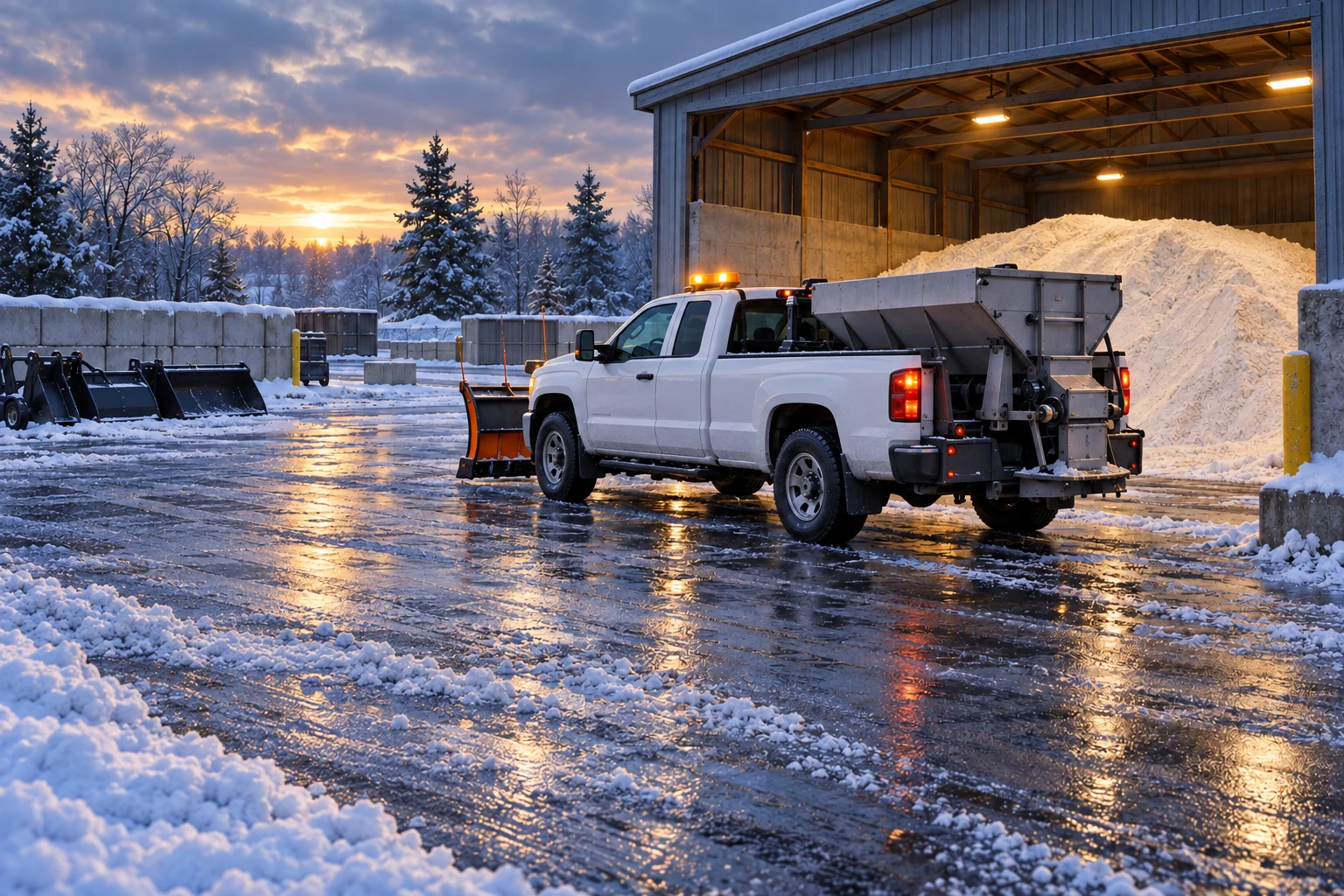
Image credit: Original illustration created for Snow Contractor with OpenAI image generation, October 17, 2026. This conceptual scene does not depict a real contractor, facility or news event.
What the latest salt news means for contractors
The Illinois story includes an important distinction: procurement trouble did not mean every local salt shed was empty. Peoria officials told 25News that the city had reserves and was not experiencing a supply shortage, while reporting a roughly 30–40% increase in its salt price.[3]
Do not use that municipal increase as a national contractor price benchmark. Your useful number is a current quote for your material, delivery location and purchasing terms.
In SIMA's September 14, 2026, preseason article, contractor William Moore recommends building relationships with multiple suppliers and purchasing early where storage capacity permits.[1] For a private snow operation, that advice becomes a short list of questions worth resolving before a forecast sends everyone to the same supplier.
Confirm delivery, not just a price
Use this checklist with your supplier and keep the answers with your purchasing records:
- What quantity is committed to your company, and what remains subject to availability?
- Is freight included? Are there minimum loads, additional charges or limited delivery hours?
- What lead time should you plan around during a busy storm cycle?
- How will allocations or delayed deliveries be communicated?
- Can you collect material if the supplier cannot deliver, and do you have suitable transport?
- Does your backup supplier have a different supply route, or depend on the same terminal?
A second phone number is worth having. It is more useful when you understand what that supplier can actually provide.
Check your usable inventory as well. Keep material already in storage separate from confirmed inbound deliveries and quantities you have merely requested. Choose a reorder point using your own consumption history, available storage and supplier lead times; this article does not prescribe a universal stockpile size.
Control salt use without guessing at treatment
SIMA's July 27 planning guidance recommends preseason and midseason equipment calibration, measuring properties and reviewing actual applications after storms.[8]
Make that a practical yard task: identify each spreader, record its calibration date and keep the settings and material tested with the equipment record. Follow the manufacturer's procedure and the training appropriate to your operation.
Do not respond to higher salt prices by blindly cutting every application. Treatment decisions need to account for site conditions, pavement temperature, the product, equipment and required service level. SIMA specifically cautions that salt applications are not one-size-fits-all.[8] This guide is not an application-rate chart.
For material tracking, pick clear units and use them consistently. A record that says "two loads" leaves the office guessing about hopper size and fill level. Record the product and quantity, and identify an estimate as an estimate rather than presenting it as a measured weight.
Review the shortage conversation before a storm
Put material availability on the preseason agenda with the property manager. Confirm who receives an urgent notice, how a proposed substitution gets approved and what happens if the agreed service cannot be delivered.
Have qualified local counsel review pricing adjustments, material substitutions and supply-interruption provisions. Do not assume a shortage automatically excuses performance: attorney Jared Nusbaum's July 27 SIMA article explains that a supply shortage can be relevant to a liability analysis without being a legal safe harbor.[2]
A useful client discussion can cover:
- The contracted scope and the areas that require particular attention.
- The notification and escalation process for a material problem.
- Which alternative methods or products require prior approval.
- How an approved price or scope change will be documented.
Keep the agreed decisions in writing. Do not quietly reduce service or substitute a product outside the agreement. Legal duties vary by jurisdiction and contract; this is operational planning information, not legal advice.
Know which properties are consuming your salt budget
A higher purchase price is easy to spot on a supplier invoice. Finding out which properties consumed that material requires service records.
Here is an illustrative budgeting example, not a current market quote: if a property uses 20 US short tons over a season, material at $100 per ton costs $2,000. At $140 per ton, the same quantity costs $2,800. That is an $800 increase before delivery, handling, labor or equipment costs.
Those figures help only if the quantity is credible. Build a service record that answers:
- Which property and service area did we treat?
- When did work begin and end, and who performed it?
- What material did we apply, in what quantity and unit?
- What conditions, access problems or follow-up needs did the crew observe?
Compare records with purchasing and yard inventory. Investigate differences rather than assuming every unexplained pound was applied at a customer property. Use the review to identify missing entries, inconsistent units or sites that need closer attention.
Turn the field record into an office answer
Snow Contractor's snow removal service tracking connects the property, service time, personnel, work performed, material quantity and notes in a property-based record.[6] That gives the office a place to start when a customer asks what was applied or when you need records to support material-based billing.
The free Individual plan includes one user, unlimited properties and reports by address.[4] Contractor and Pro Contractor plans include all six report types—address, person, contractor, date, storm and equipment—with Excel export, according to the current plan details, checked October 17, 2026.[4]
Start with one property and make its next real service record complete. Create your free Snow Contractor account before the first storm, so your recordkeeping process is ready when the work arrives.
Road salt shortage questions
Is there a nationwide road salt shortage for winter 2026–27?
The sources reviewed here establish previous-season supply stress and specific Illinois procurement problems, not a uniform nationwide shortage. Illinois reported resolving the contracts for the 94 participating entities described above.[9][3] Confirm conditions with your own suppliers rather than treating a regional headline as a local stock report.
Can service records replace an inventory system?
Property-level usage records answer where you recorded material use. A full inventory picture also needs opening stock, receipts, transfers, adjustments and a physical check. Treat the two as complementary records; do not assume logging a visit automatically measures the salt remaining in your shed.
What should we do first?
Confirm your available material and next delivery, then check that the crew can record quantities consistently. Schedule equipment calibration and resolve outstanding client approvals before the next weather event. Those are concrete tasks you can assign now, without guessing how much snow the winter will bring.
Sources
[1] https://resources.sima.org/snow-and-ice-resource-center/get-ready-for-winter — SIMA: Get ready for winter — William Moore, September 14, 2026 [2] https://resources.sima.org/snow-and-ice-resource-center/salt-supply-shortage-contract-management — SIMA: Salt supply shortage contract management — Jared Nusbaum, July 27, 2026 [3] https://www.25newsnow.com/2026/10/16/central-illinois-municipalities-ready-winter-despite-illinois-possible-road-salt-shortage — 25News: Central Illinois municipalities ready for winter — Angeles Ponpa, October 15, 2026 (CDT) [4] https://snow-contractor.com/pricing — Snow Contractor pricing — checked October 17, 2026 [6] https://snow-contractor.com/snow-removal-service-tracking — Snow Contractor service tracking — checked October 17, 2026 [8] https://resources.sima.org/snow-and-ice-resource-center/mitigate-salt-risk-with-planning?hsLang=en — SIMA: Mitigate salt risk with planning — Phill Sexton, July 27, 2026 [9] https://resources.sima.org/snow-and-ice-resource-center/the-salt-squeeze?hsLang=en — SIMA: The salt squeeze — Phill Sexton, July 27, 2026