Image: Team at snow-contractor.com
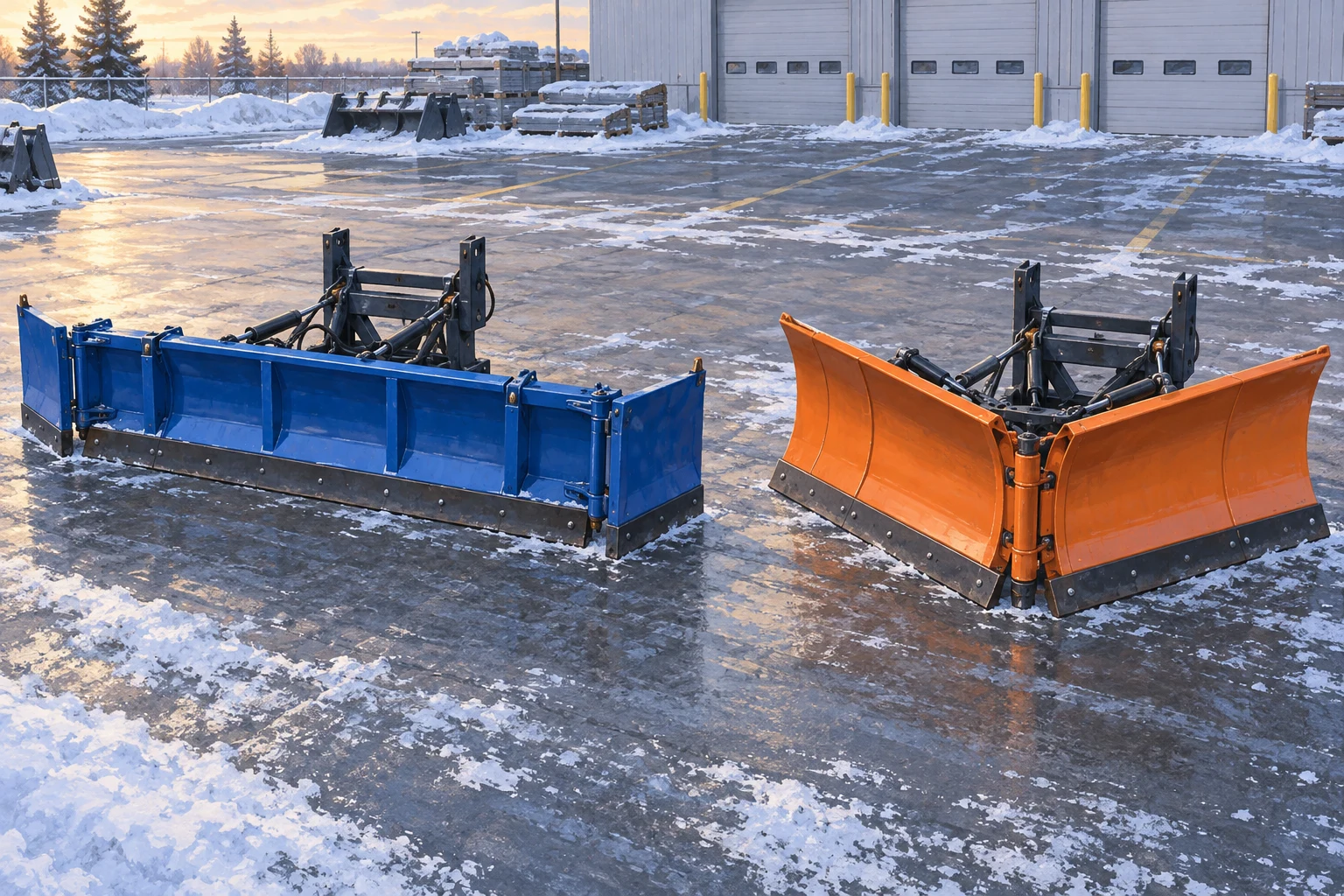
Expandable plow vs. V-plow is a buying decision about the work your truck does. A truck opening access and detailing around islands has a different assignment from one clearing an entire parking lot. Start there before comparing blade widths or accepting a faster-plowing claim.
The timing is useful for buyers reviewing equipment after the October 20–23, 2026 Equip Exposition. SnowEx's event announcement advertised an outdoor demo area; it did not provide a comparative performance test.[17] A demonstration can help you understand the controls. Your own route still has to justify the purchase.
The argument changes when a loader follows the truck
In a March 2014 PlowSite discussion, one self-described subcontractor explained why he preferred a V: his truck opened access, backdragged and worked around light poles while a backhoe with a pusher handled bulk clearing. Another participant preferred an expandable because he could retract it for a tight opening, then widen it for a loading dock.[11]
Those are historical operator accounts, not a test of today's machines. They nevertheless identify a useful distinction: are you buying the truck's primary snow-moving tool, or a tool that supports another machine?
Snow Plow News' March 2022 dealer interviews made a similar distinction. Jeen Stork favored the V for opening deeper snow and the expandable for carrying snow while keeping up with a parking lot.[10] That is an experienced seller's opinion, not proof that one design always finishes first.
For a truck doing most of the open-lot work, put hydraulic width adjustment high on the demonstration list. For a truck assigned opening and detail work ahead of a larger machine, test whether the V configuration better suits those tasks. Neither recommendation requires replacing a plow that already earns its keep.
Hydraulic wings and removable wings solve different problems
An expandable straight-center plow changes its width from the cab. Some designs also let the operator change each wing's angle; others keep a fixed wing angle while sliding in and out. Green Industry Pros explained that distinction in its May 2019 manufacturer interviews.[12] Ask to see the actual positions rather than treating every product called a "wing plow" as interchangeable.
A V with approved removable extensions deserves a separate quote. The same trade article describes that option, and the PlowSite discussion includes operators who like the extra containment but disagree about removing wings when space gets tight.[11][12]
The buying question is how often your route needs a narrower blade. If the width changes at several entrances or lanes, demonstrate those transitions. If the blade can stay wide throughout its assignment, compare the installed extension cost with replacing the entire plow. Confirm the exact accessory and vehicle combination with the manufacturer or dealer; a forum description is not fitment approval.
Compare working positions, not just the advertised width
WESTERN's current tables show why the largest number on a product page is not enough. These are manufacturer specifications checked October 26, 2026, not a head-to-head trial.[13][14]
| Example configuration | Listed width in relevant positions | Listed approximate weight | |---|---|---| | WIDE-OUT XL, model 85850-1 | 8 ft 6 in retracted; 11 ft expanded; 9 ft 10 in scoop. At full angle: 10 ft 6 in expanded, 9 ft 6 in scoop.[13] | 1,120 lb, without vehicle mount.[13] | | MVP 3, 9 ft 6 in steel, model 74495 | 8 ft 6 in full angle; 8 ft 2 in scoop; 8 ft 7 in full V.[14] | 1,070 lb, without vehicle mount.[14] |
These examples do not cover every size, generation or accessory. WESTERN also lists a 10 ft 6 in MVP 3, so an older comparison saying its widest V is 9 ft 6 in is no longer a current product-range guide.[12][14]
Use the dimensions to check the positions you need at entrances and obstacles. Do not convert the difference in width into the same percentage of time saved. Width alone says nothing about the number of turns, finishing passes or time spent placing snow.
WESTERN directs buyers to vehicle-specific matching.[13][14] Have the dealer confirm the complete installed setup, including accessories and ballast requirements, against the truck manufacturer's ratings. The bare-plow weight is not a loaded-truck assessment.
Price the time you can actually recover
Request comparable installed quotes and ask what each includes. Keep mounts, controls, lighting, edges and optional wings visible in the comparison. Ask about parts availability for the exact model, rather than assigning a reliability score to the entire category.
For a demonstration, agree on the finished result first. Compare total time for opening, bulk clearing, tight areas and final snow placement under comparable conditions. Record any help from another machine. A faster long pass is useful only if it shortens work you otherwise have to pay for or frees capacity you can sell.
Here is a hypothetical example, not a dealer quote or measured result. Suppose one option costs $2,400 more installed. Assume it saves 10 minutes across the assigned route on each of 40 service rounds, and that recovered time is worth $90 per hour. That is about 6.7 hours and $600 per year, giving a four-year simple payback before financing, additional repairs or resale differences. If the saved minutes do not reduce cost or create usable capacity, that $600 is not a cash saving.
Make the next purchase answer a specific problem
Keep enough operating history to distinguish a slow property from a slow attachment. Snow Contractor's paid Contractor and Pro Contractor plans include reports by equipment and storm, Excel export, and equipment logs and rates.[15] Use those records to support the buying discussion; they do not automatically establish which blade caused a time difference.
You can start organizing property history with the free one-user plan and its address reports. Full equipment reporting is a paid-plan feature.[15] Review reporting and plan limits, or create a free account.
Bring the dealer a specific constraint: a narrow dock, repeated width changes, an opening assignment, or too much time moving snow across open pavement. Ask both shortlisted setups to demonstrate that work. Buy the configuration that addresses it at a cost your route can support.
Sources
[10] https://snowplownews.com/snowplow-poll-v-plow-vs-expandable-box-plow [11] https://www.plowsite.com/threads/expandable-plow-vs-v-plow.154395 [12] https://www.greenindustrypros.com/snowpro/article/21068205/why-a-contractor-might-want-a-wing-plow [13] https://westernplows.com/products/wide-out-wide-out-xl [14] https://westernplows.com/products/mvp-3 [15] https://snow-contractor.com/pricing [17] https://snowexproducts.com/news-events/equip-expo-2026